Ads by Google

Sunday, July 10, 2011

Converting Inkscape Svg layers into Beamer overlays

This might be useful for those using Inkscape and know something about Beamer.  If you don't know anything about LaTeX, then this is not going to be useful.  From the project page

takes an Inkscape .svg as input, and generates pdf files corresponding to each of the layers and a LaTeX file that uses the LaTeX Beamer commands to incrementally overlay them. 

If you use Beamer to make your presentations and Inkscape to draw, then this might be potentially useful though I daresay people would tend to use PGF with BeamerPGF examples can be found here.
Presentation Zen: Simple Ideas on Presentation Design and DeliveryThe Presentation Secrets of Steve Jobs: How to Be Insanely Great in Front of Any AudienceTypesetting Tables with LaTeX

Saturday, July 9, 2011

Gnus Tip: Deleting Incoming mail files automatically

When Gnus reads in incoming mail, it stores a copy of the slurped file as Incomingxxxx in the ~/Mail folder as a backup.  These files get deleted by default after 10 days.  If you need to change it to something else or delete it immediately upon reading into Gnus, add the following to your .gnus or gnus.el file.

;;if retrieving from spool, delete temp file after 1 day(s)
(setq mail-source-delete-incoming 1) ;; change 1 to t to immediately delete or any number
(setq mail-source-delete-old-incoming-confirm nil)

More information on these and other options can be found in the Mail Source Customization in the Gnus Manual.

qmailPGP & GPG: Email for the Practical ParanoidThe Book of IMAP: Building a Mail Server with Courier and Cyrus

Friday, July 8, 2011

Gnus Tip: Show unread articles in Summary Buffer

The simplest way to show a mix of read and unread messages in your Summary Buffer is to add the following to the Group Parameters.

((display . 100))

You can change that number which tells Gnus to display the last 100 articles to any number that you want.  And while you're at it, you might as well read the other customisation options to Group Parameters.

The Exim SMTP Mail Server: Official Guide for Release 4sendmail, 4th EditionPro Open Source Mail: Building an Enterprise Mail Solution (Expert's Voice in Open Source)

Thursday, July 7, 2011

Org-mode 7.6 released

From the org-mode mailing lists, a new release of org-mode can be downloaded here or here.

Key new features include OpenDocument support, new keybindings, babel and lilypond support apart from bug fixes.

If you use git, you may have to do a git pull to get the latest.

 Getting Things Done: The Art of Stress-Free ProductivityLeave the Office Earlier: The Productivity Pro Shows You How to Do More in Less Time...and Feel Great About ItYour Creative Brain: Seven Steps to Maximize Imagination, Productivity, and Innovation in Your Life (Harvard Health Publications)

The End of Patents?

In a article titled In a Bill, Wall Street Shows Its Clout, the NYT outlined a bill which is winding its way through the US Congress for approval that outlines a fantastic opt-out-if-i-don't-feel-like-paying by Financial firms.

Now, the issue is not the about the firms themselves but the language in the bill.

Some quotes

The provision even allows “retroactive reviews of approved business method patents, allowing the financial services industry to challenge patents that have already been found valid both at the U.S. Patent and Trade Office and in Federal Court,”
 ...
It covers patents for “a financial product or service” as well as “corresponding apparatus for performing data processing or other operations used in the practice, administration, or management of a financial product or service.”

Basically, it allows firms to challenge and invalidate patents and processes that were already approved by Courts and the Patent Office. 

How and why on earth would anyone file for patents then, if this gets through?  Imagine, slogging on a very clever solution and that gets usurped by a version of the Greater Common Good theory (albeit for some vested interest).  That a patent allows an inventor a limited monopoly to make money is one key incentive...take away that, what's in it for him?


Please don't say, let them go the trade secret route where it can be reverse engineered in a matter of months.

And of course, there is the massive damage to Patent Firms, companies that have amassed portfolios of patents; their business model is in tatters.  Lots of companies make money by simply licensing patents and they'd no longer have a revenue stream from their patents.

It really would be the end of patents.
Patents and How to Get One: A Practical HandbookIntellectual Property: The Law of Trademarks, Copyrights, Patents, and Trade Secrets for the ParalegalThe Entrepreneur's Guide to Patents, Copyrights, Trademarks, Trade Secrets & Licensing

Wednesday, July 6, 2011

Calfw - A calendar framework for Emacs

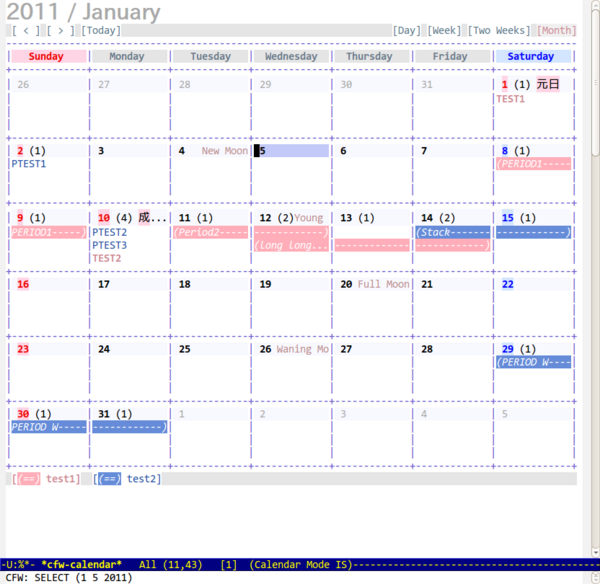
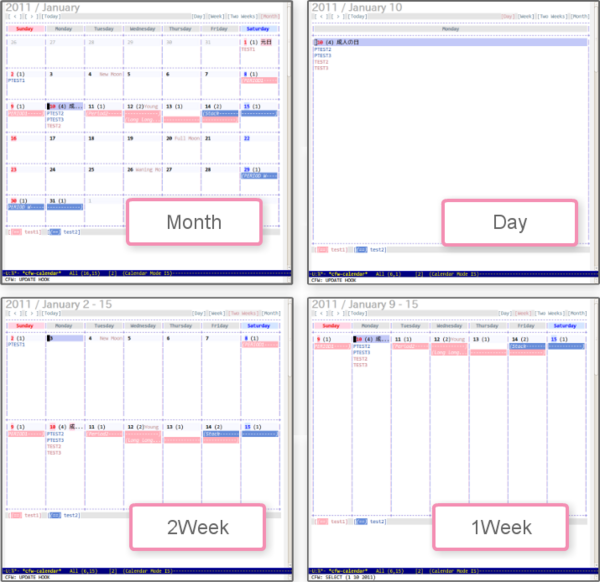
From the org-mode mailing lists, here's an interesting view of the same agenda/calendar of org-mode similar to what you see in Google Calendar developed by SAKURAI Masashi.


This is not part of the org-mode development tree and you'd have to download the package from the github repository.   It might be a good idea to try it and give your feedback on the thread here.


Getting Things Done: The Art of Stress-Free ProductivityGTDĀ® System GuidesReady for Anything: 52 Productivity Principles for Getting Things Done

Monday, July 4, 2011

A better London Underground Map?

From the Economist Daily Chart (Which I strongly suggest, you subscribe to the RSS feed), it appears someone has gone to the trouble of designing a geographically accurate map of the London Underground.

If you've been to London and used the Tube, the standard map is itself a nice informative chart, worthy of a Tufte mention, I'd say.  Anything that goes to improve on that, gets my vote.  While I don't claim to have any special knowledge of London Tube stations, the fact that some stations are closer to each other above ground than what is on the standard map would save you that bit of aggravation exactly when you need to rush or are late to some meeting. 

Of course, if you're used to the standard map, this might take some getting used to but if you've never been there and it's your first time, might as well try the new one.   Obviously, you're getting to miss the long running track and repair changes information that is published along with the standard map.   But as the designer suggests, take both with you.

Underground London: Travels Beneath the City StreetsLondon's Underground (11th edition)The Visual Display of Quantitative InformationEnvisioning Information

Friday, July 1, 2011

2011 CWE/SANS Top 25 Most Dangerous Software Errors

Through lwn.net, the top 25 dangerous software Errors can be found here.  Makes for some nice or frightening reading depending upon your point of view. It is a bit weird that

Buffer Copy without Checking Size of Input ('Classic Buffer Overflow')

is still there and at an astounding 3rd place.  I was under the impression that the new C/C++ standards would have done and fixed that at the compiler level or something of that sort. Again, assuming the bulk of these errors were in C/C++.

Makes me think that the OpenBSD folks were in the right to fix things by changing the insecure libraries so that this kind of error cannot be triggered at all.

And oh, I do like this one too

Use of Hard-coded Credentials

even mentioning espionage implications and Stuxnet.

Go on, read the full list here.

Beautiful Security: Leading Security Experts Explain How They ThinkIntroduction to Security, Eighth EditionSecure Architectures with OpenBSD


Sunday, June 26, 2011

A simpler search: Emacs Occur

The Emacs manual has a section devoted to search and replacement exploring a multitude of options to search and replace text.  You should at least be familiar with
`C-s'
     Incremental search forward (`isearch-forward').
`C-r'
     Incremental search backward (`isearch-backward').
Anything a bit more complicated than that, you need to dive into the manual.

And if you really do read the section end to end, you'd see the last part on Other Repeating Search.

And you'll find another simple search M-x occur. Call it, supply the search string and that's it.  It provides all the matches in another buffer, each line clickable to take you to the specific line  in the source file or buffer where the match was made.  It is also mapped to M-x list-matching-lines.  And if you want to search multiple buffers, there's M-x multi-occur and M-x multi-occur-in-matching-buffers, the latter that takes a regular expression for file names.

And if you do want a bit of context to the matches, supply a prefix argument and it will show contextual lines to the matches; i.e C-u 2 M-x occur searchtext RET will show 2 lines of context with every match. 

That's it. M-x occur is for the occasions where you can't be arsed to find the 100% correct regex and no one's watching you hacker FAIL.

And you should really read the complete section on Search and Replace.  It's well worth your time.
Mastering Regular ExpressionsRegular Expressions CookbookBeginning Regular Expressions (Programmer to Programmer)

Thursday, June 23, 2011

Emacs 24.1 heading into Pretest

A bit late to post this but it appears Emacs 24.1 feature freeze and pretesting is going to start.

Well, almost, if you look at the entire mail thread; for a release in 2012, if all goes well.

If you don't want to wait that long, you can still get the weekly builds from here.

Version Control with Git: Powerful Tools and Techniques for Collaborative Software DevelopmentPro GitProducing Open Source Software: How to Run a Successful Free Software Project